 by
by 
The second full day aboard the R/V Atlantis the science has started. As an undergraduate engineering student and a first time seaperson, I did not know what to expect on a ship, or of the science that would be conducted on a research vessel. Already this experience has opened my eyes to new interests and career paths. There is more to come, but today we got to run our first science operation and get a glimpse at what is possible.
Today’s science operation was focused on deploying a device called a CTD Rosette. The CTD gets its name because it has sensors that are able to measure electrical conductivity, temperature, depth; this device also has sensors measuring oxygen, turbidity, photosynthetically active radiation, turbidity, chlorophylls, altitude, and other sensors can be mounted as needed. The device is ‘deployed’ from the ship by a winch and is slowly lowered into the water to a desired depth. The data is logged as the device is lowered, and scientists are able to observe the data throughout the descent to decide what depth would be best to sample on the way up.
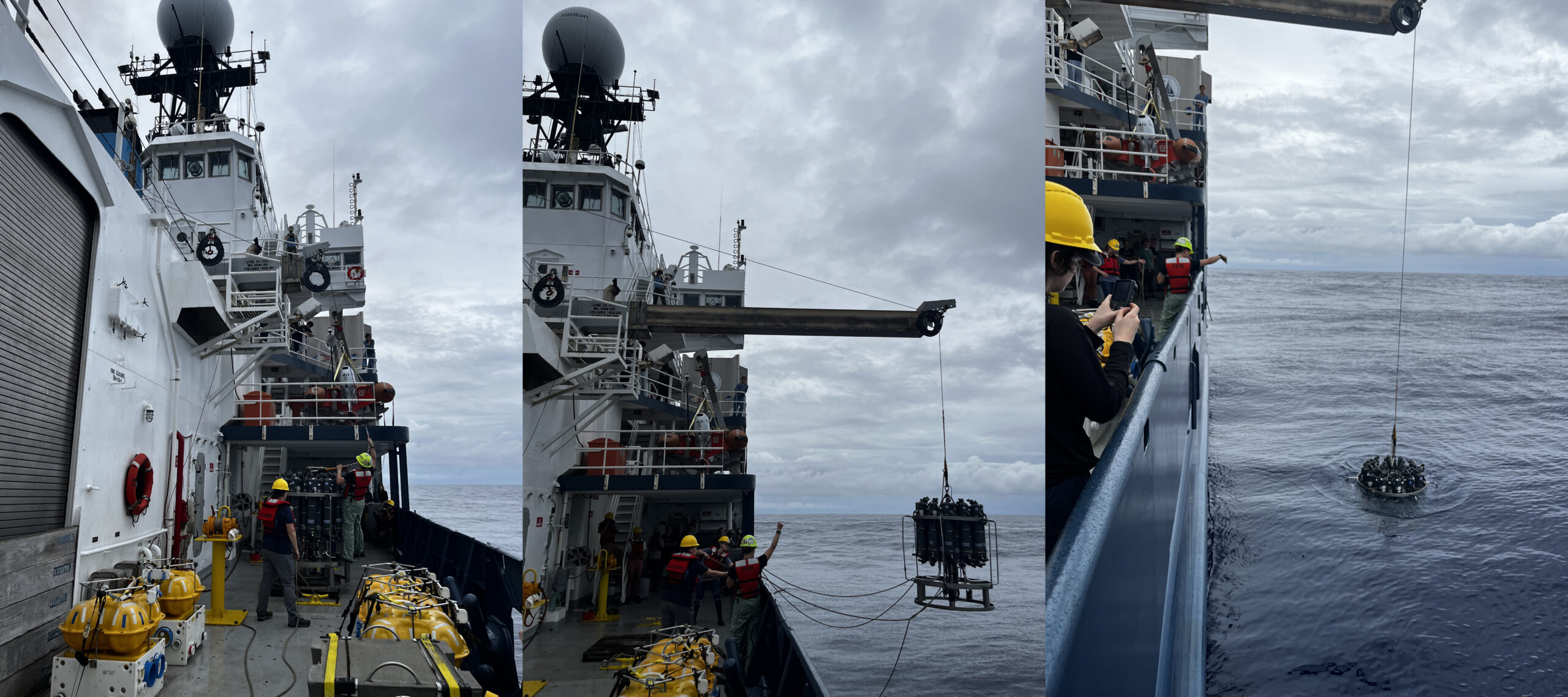
Going into this operation I knew what the device looked like and what it could measure, but I did not have an idea of what to investigate with that data. The mentors suggested gathering samples at the maximum depth, the surface and depths that corresponded to the maximum and minimum oxygen concentrations and maximum chlorophyll. We were able to filter these samples through a 10 micron mesh and compare the concentrations of phytoplankton at each depth. With more operations and time at sea I will gain ideas of what questions I would like to answer with the data we are able to collect.
Through this operation, I gained a lot of interest in deck operations and working on a research vessel as part of the boat crew. I was unaware of the job of a Marine Technician but from the observations I’ve gathered over two days I am quickly becoming very interested. My understanding so far is that Marine Techs, also known as SSSGs, are the communication point between the scientists of a research vessel and the ship’s crew. The SSSGs showed us standard operation procedures and safety, and are able to answer questions about equipment, what it does, and when it should be used.
On the science side of things, I am excited to see what else there is to test and discover.
I am also really excited to continue observing the Marine Techs and deck operations and if it is something I want to pursue for myself.