 by
by 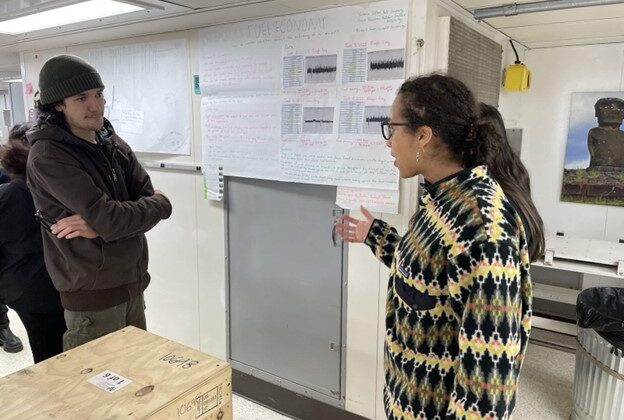
By Bishesh Shah, Cornell University
Editor’s Note: This is a delayed post from earlier in the cruise… transport yourself back in time!
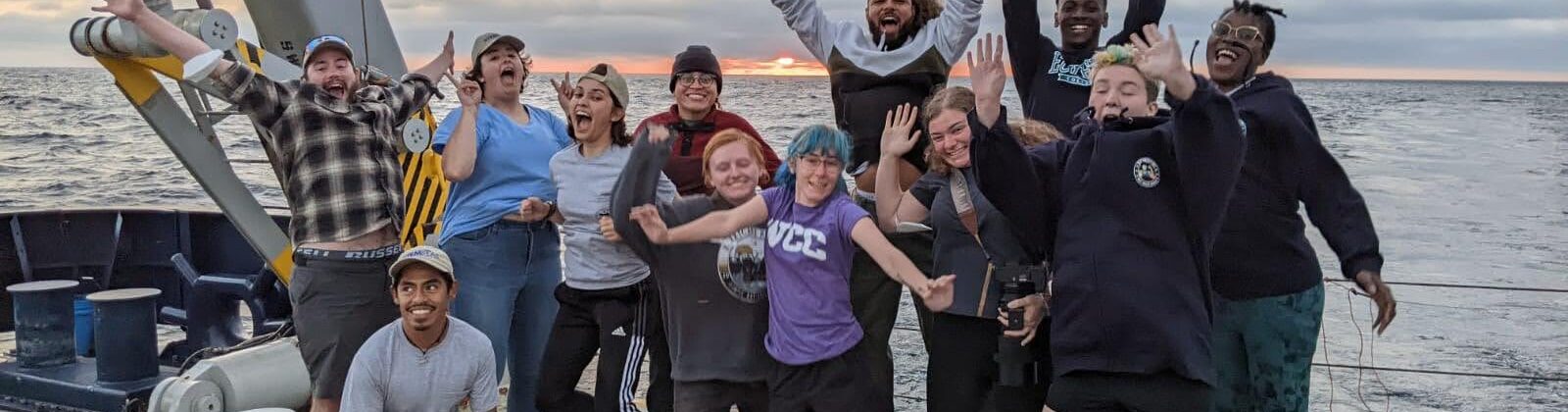
After this 2-week voyage across the Pacific Ocean, we made lifelong memories, shared countless laughs, and learned so much from each other. For the past few days, we got into groups and created scientific posters on various topics in marine science and oceanography that we were interested in. Today, we got to present all of our hard work to one another and the entire crew.
Everyone made such amazing and insightful posters, and here is a small recap of them all!
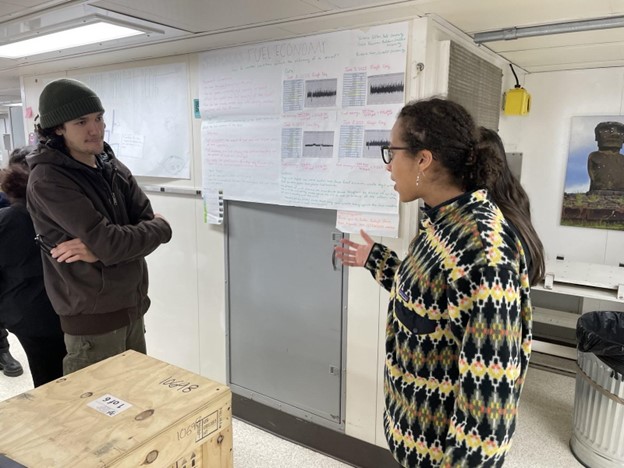
Bishesh, Victoria, and Grace did a project on the impact of waves on fuel efficiency (Figure 1). They studied the sea state and correlated that with the fuel economy (nautical miles per gallon). With a 0.01 mile/gallon difference in fuel economy between our calmest and roughest days, they concluded that there is a strong correlation between the two.
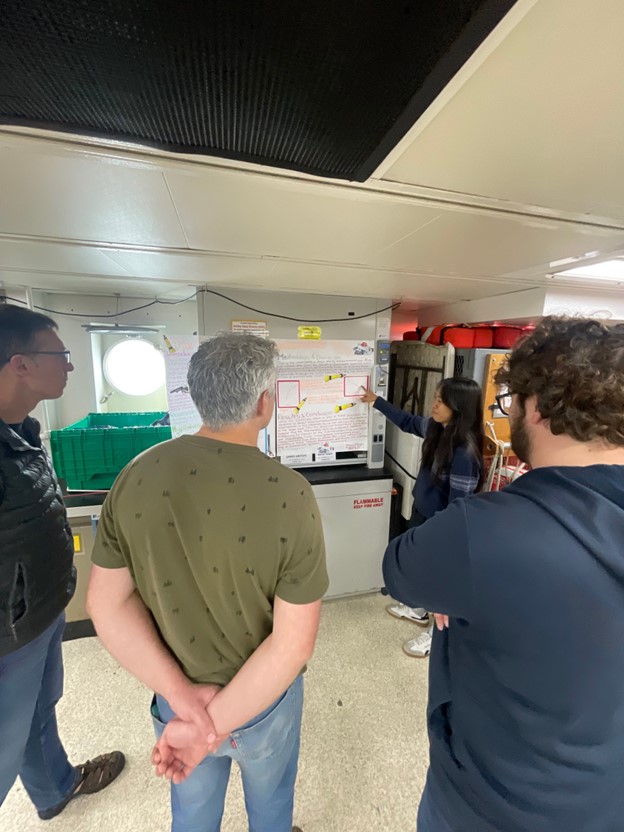
Haley and Jessica presented their project, which was on Alvin’s buoyancy in a thermocline (Figure 2). They hypothesized that due to the thermocline, the change in water density would have an impact on Alvin’s buoyancy. To conduct their project, they used data from one of James’s floats we deployed on this trip.
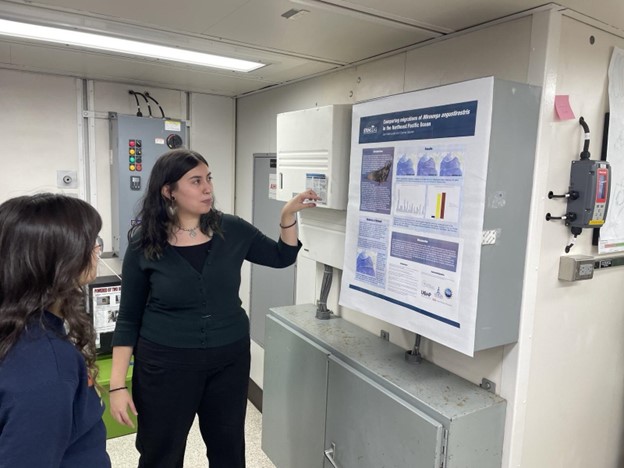
Jen and Sarina’s project hypothesized that Northern Elephant Seals were drawn to abrupt topographical features on the seafloor (Figure 3). They overlapped the migratory paths of the seals with 1 trench, 1 ridge, and 1 seamount chain and counted how many times those migration paths crossed over.
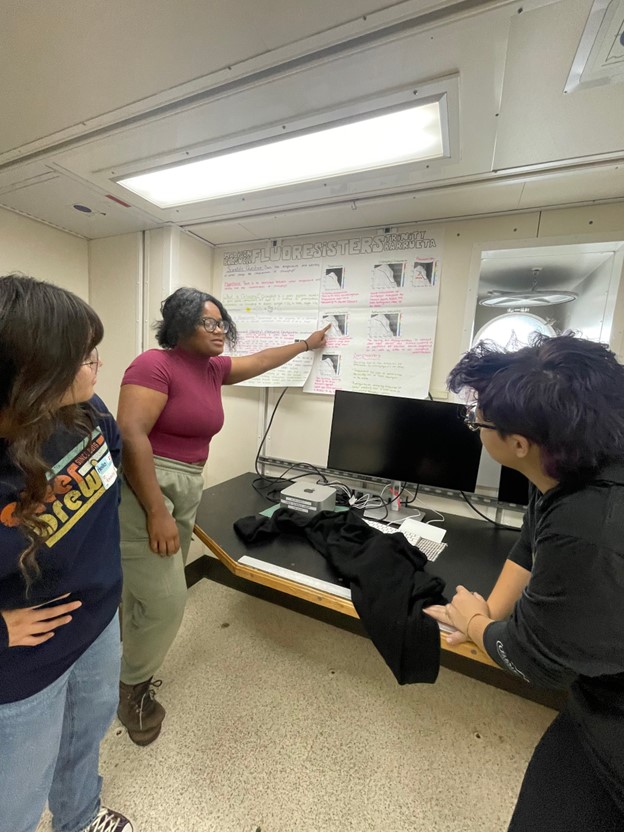
The Fluorosisters (Madison and Trinity) studied chlorophyll fluorescence along the transit path (Figure 4). They found chlorophyll concentration, pigmentation, and photosynthetic efficiency and how they compare to sea surface temperature and salinity.
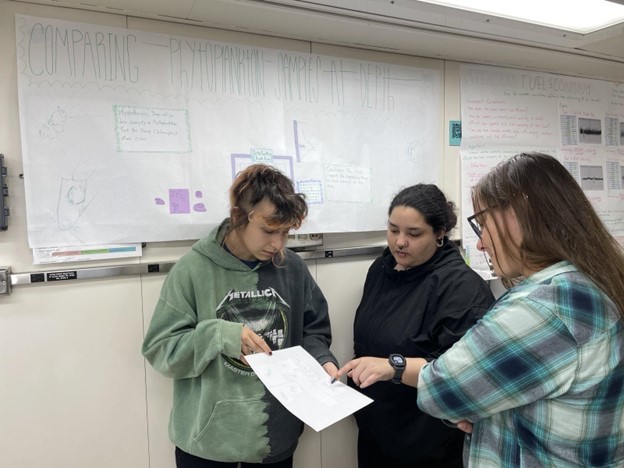
Team Chum Bucket (Rip and Fae) created a project measuring different concentrations of phytoplankton at different depths with samples from the CTD (Figure 5).
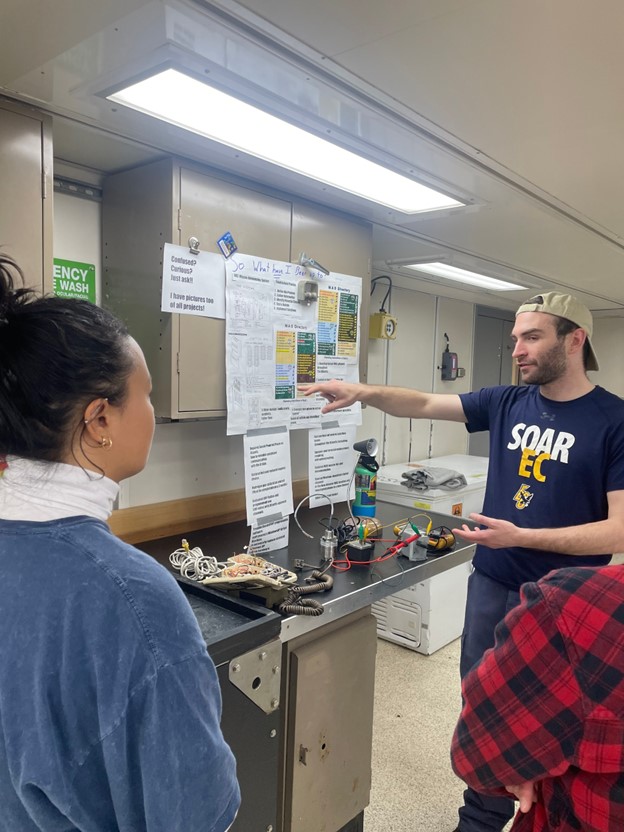
Kyle presented a snippet of the various projects he worked on with Josh, the ComET (Figure 6). He shared stories about rewiring the telecom phones and had physical components as well like a hand crank that powered a light bulb. I (Bishesh) had jumped in at different moments to tag along and it was a pleasure to see Kyle thrive and be so into the entire marine tech industry.
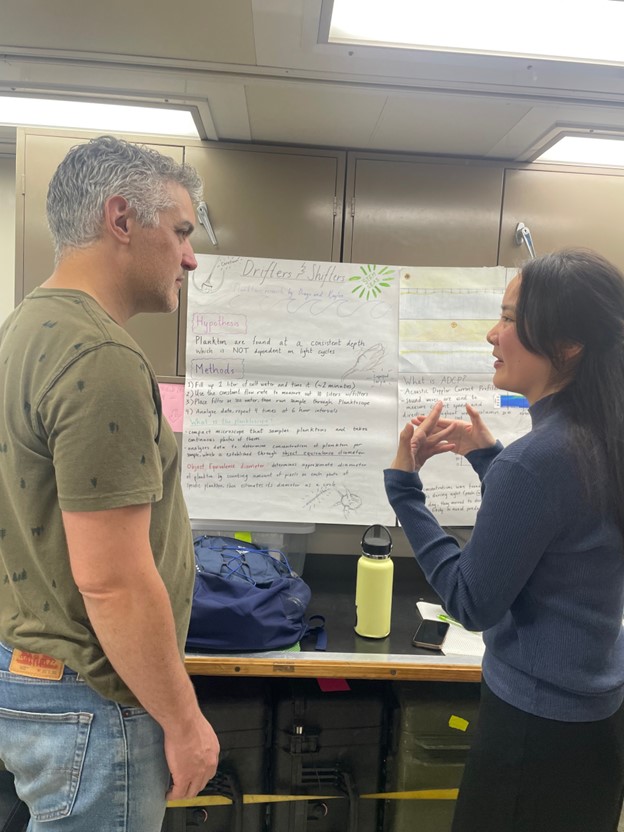
Drago and Kaylee did planktonic research using the Planktoscope (plankton microscope) to determine if plankton move throughout the vertical water column depending on the time of day. Data from ADCP and object equivalence diameter information gathered from the Planktoscope determined that plankton concentrations in shallow water are greatest during the night with the peak concentration at 0200 (that’s 2 am!).
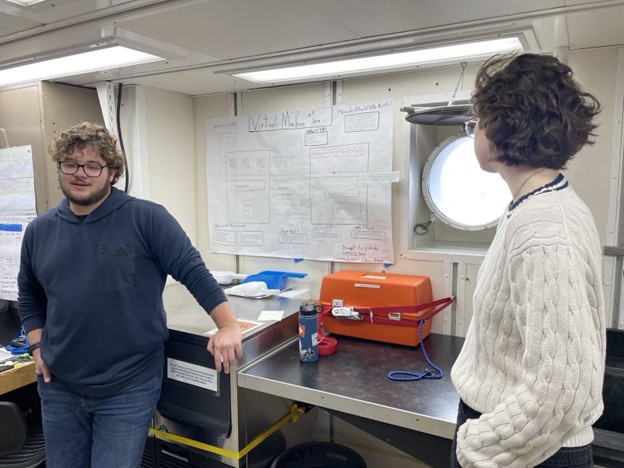
For Legend’s project, he chose to do a research project on virtual machines and how the R/V Atlantis’ virtual machine system works. He learned about and explained how the ship’s 25 virtual machines operate, how the servers are operated, and how they are connected to network storage.
It was a massive success and it was incredible to see the entire ship come together for us one last time. For the span of two weeks, this group of scientists, engineers, and crew fostered into a mini-family. Thank you STEMSEAS for this experience.