 by
by By Hayden Vega and Maliana McCollum
Our first day started the night before at 11:44PM. Some of us met on the top deck to say see you later to land, which we wouldn’t see for seven days. As we pulled from the harbor, we chatted about the day ahead—legendary breakfasts, potential dolphin sightings, and most of all, getting a taste of real oceanographic science. Little did we know, our wish would come true the very next day.
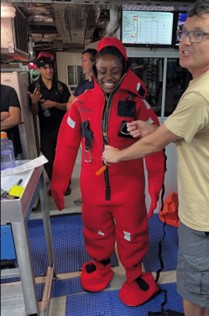
Captain Sean kicked things off with a safety briefing, but it wasn’t a dry rundown of rules. He walked us through all the things that could go wrong out at sea and what would happen if the ship was actually going down. To really bring it to life, our friend Khirah stepped up as the volunteer. She wriggled into one of the big red immersion suits, zipped up snug like a giant human gummy bear, and gave us the full demonstration. We couldn’t help but laugh, but it definitely got the point across. After we finished the demo, we headed to our first science activity of the day.
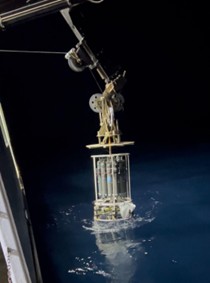
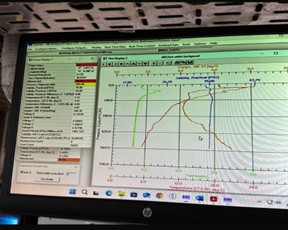
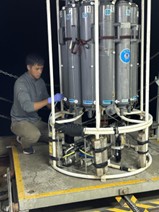
Dr. Nicole Millette, our voyage’s chief scientist, gathered us in the ship’s lab. She showed us a niskin rosette that the ship’s crane was lowering into the waves. The niskin rosette was a five by four cylindrical metal frame surrounded with large gray bottles on its interior, and over one hundred pounds of lead so it could sink to the bottom of the ocean. On its journey, the bottles on the rosette would collect water samples from 1 meter deep to 2,000 meters deep–roughly double the length of the world’s tallest skyscraper. Not only that, but the rosette would create a profile of the water in real time, showing how photosynthesis, temperature, salinity, and oxygen changed as we plunged deeper into the ocean. But we had a problem. At 2,000 meters, the winch began to fail. The line connecting the rosette to the vessel began to slip off its track, so we had to take the next 1,999 meters gingerly; the two-hour journey down would take four hours coming back up. With an extra two hours before sample processing, we all took a long lunch.
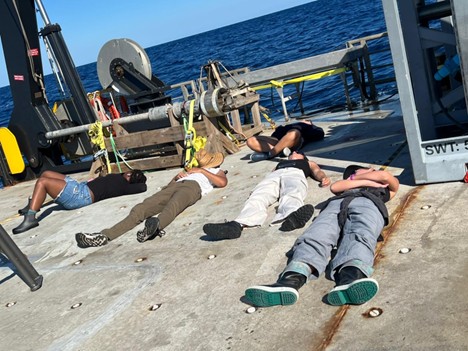
During down time we all took to various forms of relaxation before having a busy evening of field work. Some students took to checking in on the first week of school assignments, while others enjoyed a very peaceful nap on deck.
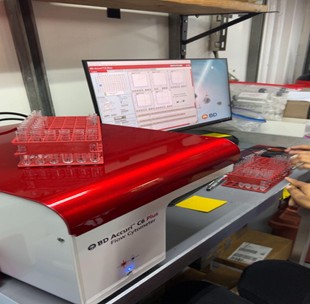
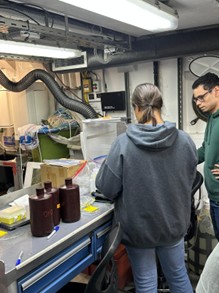
After a much-needed break, we jumped back into action, and it was time to start sampling. We collected water from the Niskin bottles and brought it into the lab to begin the filtering process. Setting up the filtering station late at night was a bit of a challenge, but also an exciting learning experience. While one group focused on filtering, another ran samples through the Flow Cytometer, a process that required patience since the machine can only operate at a set pace. The Flow Cytometer itself is fascinating, it uses lasers to measure the presence of bacteria and phytoplankton in real time, providing us with precise data.
Once filtering was complete, the group carefully transferred the filters onto slides, added cover slips, and sealed the edges with a thin coat of clear nail polish. It was a hectic, late night, but worth every moment.
We got a true glimpse into what life as a research scientist can look like, not just the exciting, polished side, but also the unpredictable side where experiments don’t always go as planned. In science, flexibility is key in this field as things shift constantly, and setbacks are part of the process. Still, we’re grateful for the chance to experience it firsthand.